Friday, October 28, 2011

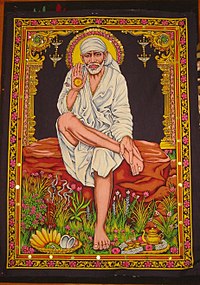
Shirdi Sai Baba | Shri SaiBaba

Puttaparthi, where Sathya Sai Baba was born and lived, was originally a small, remote South Indian village in Andhra Pradesh. Now there is an extensive university complex, a speciality hospital, and two museums: the Sanathana Samskruti or Eternal Heritage Museum, sometimes called the Museum of All Religions, and the Chaitanya Jyoti, devoted exclusively to the life and teachings of Sathya Sai Baba; the latter has won several international awards for its architectural design. There is also a planetarium, a railway station, a hill-view stadium, an administrative building, an airport, an indoor sports stadium and more. High-ranking Indian politicians such as the former President Dr. A. P. J. Abdul Kalam, former Prime Minister Atal Bihari Vajpayee, Andhra Pradesh former Chief Minister Konijeti Rosaiah and Karnataka Chief Minister B. S. Yeddyurappa have been official guests at the ashram in Puttaparthi. On Sathya Sai Baba's 80th birthday celebration, it was reported that well over a million people attended, including 13,000 delegates from India and 180 other countries.
The Sri Sathya Sai General Hospital was opened in Whitefield, Bangalore, in 1977 and provides complex surgeries, food and medicines free of cost. The hospital has treated over 2 million patients.
Devotees said they observed Sathya Sai Baba manifesting vibhuti (holy ash), and sometimes food and "small objects" such as rings, necklaces and watches. In books, magazines, filmed interviews and articles, Sathya Sai Baba's followers reported miracles of various kinds that they attributed to him. Internationally, devotees reported that vibhuti, kumkum, turmeric powder, holy water, Shiva lingas, statues of deities (brass and gold), sugar candy, fruits, herbs, amrita (a fragrant, nectar-like honey), gems, colored string, writings in ash and various other substances spontaneously manifested and materialized on the walls, furniture, pictures and altars of Sathya Sai Baba. Sathya Sai Baba's devotees also believed that he relieved them from pain, by transferring it to himself.
In 1963, Sathya Sai Baba suffered a stroke and four severe heart attacks. It is believed that he healed himself of these in front of the thousands of people gathered in Prasanthi Nilayam praying for his recovery. On recovering, Sai Baba gave a discourse announcing that he would be reborn as Prema Sai Baba in the neighboring state of Karnataka. He stated, "I am Siva-Sakthi, born in the gotra (lineage) of Bharadwaja, according to a boon won by that sage from Siva and Sakthi. Siva was born in the gotra of that sage as Sai Baba of Shirdi; Siva and Sakthi have incarnated as Myself in his gotra now; Sakthi alone will incarnate as the third Sai (Prema Sai Baba) in the same gotra in Mandya district of Karnataka State." He stated he would be born again eight years after his death at the age of 96.
Devotees generally responded to allegations such as those of sexual misconduct with outright denial, asserting that ex-followers were vindictive and not reputable – fickle people who one day sang Sathya Sai Baba's praises and then turned against him when some wish of theirs wasn't fulfilled. A second common response was that even if some of the allegations by critics were correct, they simply lacked the vision to understand things in their correct spiritual context, or were failing to understand the meaning of lila, Sathya Sai Baba's divine play. Devotee Bill Aitken was quoted by The Week as saying that Sathya Sai Baba's reputation had not been harmed by the negative stories published about the guru. He said that the more detractors railed against Sathya Sai Baba, the more new devotees went to see him. In the article Divine Downfall, published in the Daily Telegraph, Anil Kumar, the ex-principal of the Sathya Sai Educational Institute, said that he believed that the controversy was part of Baba's divine plan and that all great religious teachers had to face criticism during their lives. Anil Kumar also said that allegations had been leveled at Sathya Sai Baba since childhood, but with every criticism he had become more and more triumphant.

Shirdi Sai Baba | Shri SaiBaba
Sathya Sai Baba Wikipedia
SPREADING SAI BABA S NAME AND
Saibaba Picture Gallery
Prior to his death Baba spent
Sathya Sai Baba
Sathya Sai Baba
Sri Sai Baba s Charters
Sai Baba Onam photos Onam
sai baba
sai baba
Sri Shirdi Sai Baba Temple of

U S Air Force

The 426th Tactical Fighter Training Squadron converted from F-4 Phantom II to F-15 training in January 1981 specifically to support the TAC Air Defense Command (ADTAC) training mission inherited from the inactivated Aerospace Defense Command which was merged into TAC. On 19 November 1990, the 555th TFTS changed its course from air superiority combat training with the Eagle to air defense interceptor training with the F-15C/D when TAC began assigning F-15s to interceptor duty, the 426th being inactivated.
Adair · Beale · Bong (unbuilt) · Charleston · Davis-Monthan · Dobbins · Dover · Dow · Duluth · England · Ent · Ethan Allen · Fairfax · Fort Lee · Geiger · George · Glasgow · Grand Forks · Grenier · Griffiss · Gunter · Hamilton · Hancock · Homestead · Hurlburt · Imeson · K.I. Sawyer · Kincheloe · Kingsley · Kirtland · Larson · Luke · March · Malmstrom · McCoy · McChord · McClellan · McGhee Tyson · McGuire · Minneapolis-St. Paul · Minot · Mitchel · New Castle · Niagara Falls · Norton · O'Hare · Oklahoma City · Otis · Oxnard · Paine · Perrin · Peterson · Pittsburgh · Pope · Portland · Presque Isle · Richards-Gebaur · Selfridge · Seymour Johnson · Sioux City · Snelling · Stead · Stewart · Suffolk County · Tinker · Travis · Truax · Tyndall · Vandenburg · Webb · Westover · Willow Run · Wright-Patterson · Wurtsmith · Youngstown
The 310th and 311th TFTS retained their F-4Cs until April 1982, ending the Phantom era at Luke, receiving Block 1 F-16A Fighting Falcons in November 1982 and April 1983. Luke-based F-16s began carrying tail codes "LF". 310th TFTS officially began training fighter pilots 2 February 1983.
For several years, the Armed Forces Special Weapons Project at Sandia Base, New Mexico, had provided all atomic, biological, and chemical (ABC) warfare training for the Air Force. Beginning in October 1954, ATC added ABC instruction to its fighter pilot programs at Luke and Nellis. In addition, ATC established six general ABC courses to train aircrews already in the field, using mobile training teams.
On 1 October 1991, due to the implementation of the Objective Wing at Luke and the "One base, one wing" policy, the 405th TTW was shut down and the F-15s were reassigned back to the 58th TTW.

U S Air Force
U S Air Force
The Us Air Force is also in
Air Force 1 � Air Max Change
Nike Air Force I Collection
Consider Becoming an Air Force
to join the US Air Force
sunset USA air force
College Profiles Air Force
21 February 2008 Air Force
05/16/2009 Air Force 1 High
Air Force One
Air Force One
Royal Australian Air Force Air
Nike Air Force 1 Bespoke by
Air Force ROTC DET 805
05/16/2009 Air Force 1 Mid
Eighth Air Force emblem

Thursday, October 27, 2011

Business Development Starts

Looking to forestall the impending legal imbroglio, in early 1954 Hughes offered to buy out all of RKO's other stockholders. Convinced that the studio was sinking, Walt Disney ended his arrangement with RKO and set up his own distribution firm, Buena Vista Pictures. By the end of the year, at a cost of $23.5 million, Hughes had gained near-total control of RKO Pictures, becoming the first virtual sole owner of a studio since Hollywood's pioneer days. Virtual, but not quite actual. Floyd Odlum reemerged to block Hughes from acquiring the 95 percent ownership of RKO stock he needed to write off the company's losses against his earnings elsewhere. Hughes had reneged on his promise to give Odlum first option on buying the RKO theater chain when he divested it and was now paying the price. With negotiations between the two at a stalemate, in July 1955, Hughes turned around and sold RKO pictures to the General Tire and Rubber Company for $25 million. For Hughes, this was the effective end of a quarter-century's involvement in the movie business. Historian Betty Lasky describes Hughes's relationship with RKO as a "systematic seven-year rape."
The company also began a close working relationship with Ida Lupino. She starred in two suspense films with Robert Ryan—Nicholas Ray's On Dangerous Ground (1952, though shooting had been completed two years earlier) and Beware, My Lovely (1952), a coproduction between RKO and Lupino's company, The Filmakers. Of more historic note, Lupino was Hollywood's only female director during the period; of the five pictures The Filmakers made with RKO, Lupino directed three, including her now celebrated The Hitch-Hiker (1953). Exposing many moviegoers to Asian cinema for the first time, RKO distributed Akira Kurosawa's epochal Rashomon in the United States, sixteen months after its original 1950 Japanese release. The only smash hits released by RKO in the 1950s came out during this period, but neither was an in-house production: Goldwyn's Hans Christian Andersen (1952) was followed by Disney's Peter Pan (1953).
Along with Columbia Pictures, RKO became one of the primary homes of the screwball comedy. As film historian James Harvey describes, compared to their richer competition, the two studios were "more receptive to experiment, more tolerant of chaos on the set. It was at these two lesser 'majors'...that nearly all the preeminent screwball directors did their important films— Hawks and La Cava and McCarey and Stevens." The relatively unheralded William A. Seiter directed the studio's first significant contribution to the genre, The Richest Girl in the World (1934). The drama Of Human Bondage (1934), directed by John Cromwell, was Bette Davis's first great success. Stevens's Alice Adams and director John Ford's The Informer were each nominated for the 1935 Best Picture Oscar—the Best Director statuette won by Ford was the only one ever given for an RKO production. The Informer's star, Victor McLaglen, also took home an Academy Award; he would appear in a dozen movies for the studio over a span of two decades.
After a year and a half without a notable success, General Tire shut down production at RKO for good at the end of January 1957. The Hollywood and Culver City facilities were sold later that year for $6.15 million to Desilu Productions, owned by Desi Arnaz and Lucille Ball, who had been an RKO contract player from 1935 to 1942. Desilu would be acquired by Gulf and Western Industries in 1967 and merged into G+W's other production company, Paramount Pictures; the former RKO Hollywood studio became home to Paramount Television (now CBS Paramount Television), which it remains to this day. The renovated Culver City studio is now owned and operated as an independent production facility. Forty Acres, the Culver City backlot, was razed in the mid-1970s. List Industries, the former RKO Theatres Corp., was acquired by Glen Alden Corp. in 1959. After Glen Alden's 1967 acquisition of the Stanley Warner theater group, the two chains were merged into RKO–Stanley Warner Theatres. Cinerama purchased the exhibition circuit from Glen Alden in 1971.
In September, Hughes and his corporate president, Ned E. Depinet, sold their RKO studio stock to a Chicago-based syndicate with no experience in the movie business; the syndicate's chaotic reign lasted until February 1953, when the stock and control were reacquired by Hughes. The studio's net loss in 1952 was over $10 million, and shooting had taken place for just a single in-house production over the last five months of the year. During the turmoil, Samuel Goldwyn ended his 11-year-long distribution deal with RKO. Wald and Krasna escaped their contracts and the studio as well. The deal that brought the team to RKO had called for them to produce sixty features over five years; in just shy of half that time, they succeeded in making four. The Encino backlot shut down permanently in 1953 and the property was sold off. In November, Hughes finally fulfilled his obligations under the 1948 consent decree, divesting RKO Theatres; Albert A. List purchased the controlling interest in the business and renamed it List Industries. Hughes soon found himself the target of no less than five separate lawsuits filed by minority shareholders in RKO, accusing him of malfeasance in his dealings with the Chicago group and a wide array of acts of mismanagement. "RKO's contract list is down to three actors and 127 lawyers", quipped Dick Powell.

Business Development Starts
Business tab above
Business tab above
Business in Ukraine
Business in Ukraine
Internet Business Consulting
COMPONENTS OF A BUSINESS PLAN
worldwide business networking
Business Consulting
Business Consulting
Business plan for web
business
business
Do You Need a Business Case
Business support information
Small Business Consulting
Business Spanish in Madrid
without business liability
Business Marketing
Business Marketing